
December 11, 2025
December 11, 2025

Another Loss in our Mayo Clinic Falcon Family
Another Loss in our Mayo Clinic Falcon Family
I recently received word from a fellow falcon and peregrine bander in Texas about a peregrine falcon they found in the Fort Worth area in November 2023. The bird was showing signs of West Nile Virus, a virus spread through infected mosquitoes or the prey they eat. The virus is most often diagnosed due to neurological symptoms such as a head tilt, disorientation, tremors, inability to perch or fly, seizures and blindness. Other common symptons include depression and lethargy, a fluffed up appearance and greenish urates (bird urine). Unfortunately, peregrine falcons often die suddenly with few prior symptoms compared to other raptors.
Although this loss is hard to hear, I also wanted to take a moment to talk about the value of reporting banded birds. Any bird banded in North America is entered into a MASSIVE database through the USGS Bird Banding Lab at the Patuxent Research Refuge. The banding lab is responsible for issuing permits and providing bands to licensed bird banders, collecting and archiving millions of records from over 1000 bird species, and analyzing bird migration, habitat use, and population dynamics to better manage species.
It's invaluable information to biologists who band birds to receive reports from the public and hunters of any banded bird they may encounter. These encounters are most often from wildlife photographers, waterfowl taken by legal hunters, or injured birds found by the public. If you do encounter ANY banded bird, I hope you will take a few minutes to report it at the link below, to help us further understand our amazing avian wildlife and the biologists who study them.
Today's photo is of Rebel and his siblings, taken during banding. And although Rebel passed too soon, we do know he survived past his most difficult first year of life and migrated to the Fort Worth, TX area. That is still valuable information to have.
November 3, 2025
November 3, 2025
Fly High Aria!
Fly High Aria!
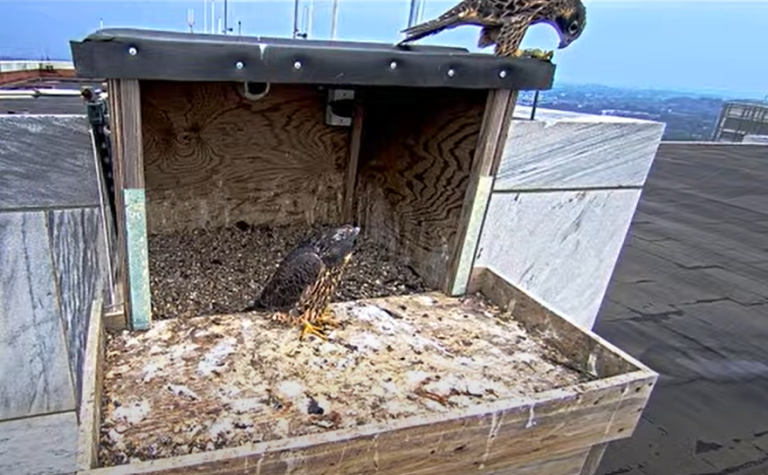
Unfortunately, I recently received some bad news about Aria, one of the 2025 fledglings from Rochester. She was found late last week in Monticello, Minnesota, approximately 125 miles NE of Mayo Clinic. She was found by a member of the public, showing signs of HPAI (High Pathogenic Avian Influenza). She was transferred to the University of Minnesota in St. Paul, for treatment, where she was examined by their veterinarians who tested her for the virus. Unfortunately, the virus was found in preliminary tests, and the decision was made to humanely euthanize her.
HPAI has recently resurfaced throughout the continent, and while some species may carry the virus and show no symptoms or suffer from the virus, other species can be significantly impacted with severe symptoms. These can include respiratory distress, swelling, paralysis, and multi-organ failure, which appear quite suddenly. Unfortunately, recovery is extremely rare, especially once severe symptoms appear in the bird. The virus is also extremely contagious and can have significant impacts on poultry or other wild bird populations. You may have noticed that the banding team used extra precautions during our banding events the past few years to minimize our possible transmission between nesting territories. This includes wearing gloves, changing clothes, disinfecting all equipment, and extra observations of a territory to determine any evidence of the virus.
While HPAI has circulated in bird populations for decades, the current global epidemic since 2020 represents a significant increase in its spread and impact across multiple species. Raptors appear to be impacted at higher levels than previous outbreaks, and there has been a recent increase in wild populations in the last two months than in earlier months this year. Jackie
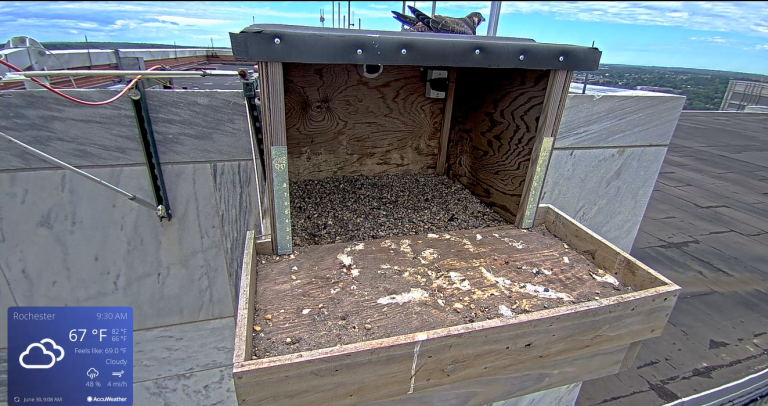
*Note: The photo shown is of Aria at the nest box on June 30, 2025
August 13, 2025
August 13, 2025
Field Update
Field Update
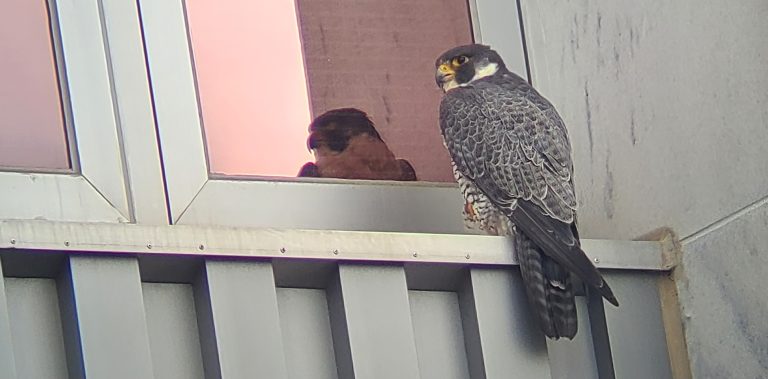
The past few weeks have been quiet with the peregrines in Rochester. Hattie and Orton continue to be easily found near the Clinic campus, perched on the Siebens, Mayo, or Plummer Buildings on each visit. That said, I haven't been able to find a fledgling since August 6th. This doesn't necessarily mean that they have left the area, it just means that there are hundreds of buildings, trees, and towers where they could be perched, and I can't cover the entire area 24 hours a day, seven days a week. The banding that we do helps with knowing the location of an individual bird at a specific time, but telemetry with a transmitter is the only way to know their location across the state, region, or country without a visual on the bird. I'll continue to make weekly visits, but I would be surprised to find Aria or Riya in the area beyond the end of the month.
The best advice I can give someone trying to find them is to start looking early in the day, taking into consideration the wind direction, sun intensity, and the height of the building. My favorite locations to observe from are the east side of the Gonda Building, generally from the 10th floor or higher.
July 5, 2025
July 5, 2025
Life as a Fledgling
Life As a Fledgling-Stages of Flight School
Riya and Aria are now at Day 21 and 23 as a Mayo Clinic fledgling...Yipee! This is a significant milestone in their life.
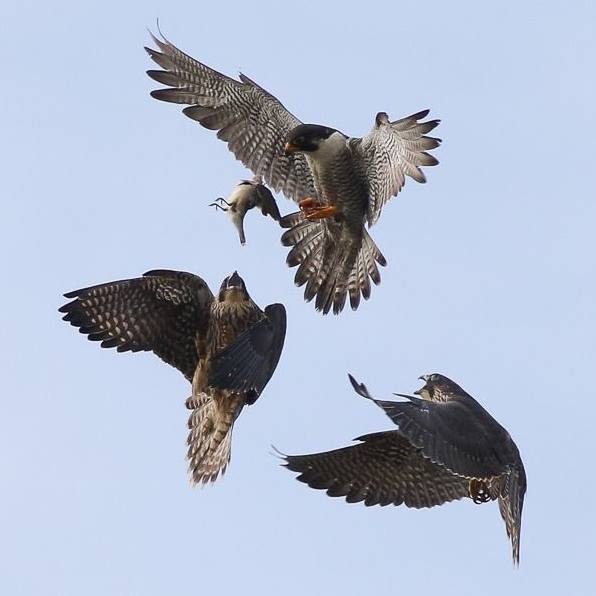
As the fledglings become more confident with their flight, they also become more aggressive towards any adult with food in their talons. The adults respond by dropping both live and dead prey in flight, with the young falcons in heavy pursuit. This is not necessarily the adults "training" the young birds, but possibly just a way for the adults from being mobbed.
The fledglings will continue to be dependent on their parents for at least another 2-4 weeks, longer in non-migrating populations (up to 10 weeks or more). Like everything in nature, there are always exceptions. Biologists have observed some falcons disappearing after only a week after fledging, only to show up as a breeding adult on territory, whereas other fledglings may remain on territory for up to six months or more!!
So far, I've observed multiple chases of the fledglings chasing Hattie and Orton with prey, with both fledglings equally participating in the chases. I haven't observed the fledglings actually taking prey themselves, but I am only on campus 1-2 times a week and rarely see a hunting flight with the adults. Within the next week or so, they should be successful in their independent hunting events due to the large amount of young prey in the area.
Thanks to everyone who shared stories of watching the falcons on campus, doing what they do best. Take advantage of their presence today, since the day will soon be here when they will no longer fly above the downtown Rochester campus. Lastly, the fledges are also still making a visit to the nest box, so don't forget to continue checking in - you never know who might be home.
NOTE: Today's photos is a photo of an Ohio peregrine family, copyright Chris and Chad Saladin.
June 16, 2025
June 16, 2025

The Return of the Wanderers!
June 16, 2025
So far, Aria and Riya have survived their first few days of flight and exploring Rochester's Mayo Clinic campus and the surrounding areas in downtown. Perfect way to end a Monday night of storms
June 14, 2025
June 14, 2025
Riya has gained her wings!
June 14, 2025
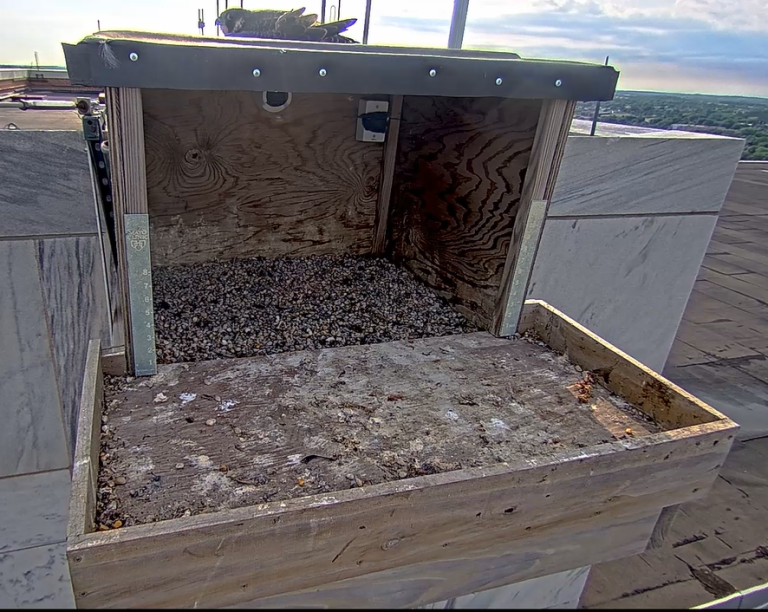
Sometime between 2:15 pm and 2:19 pm CT today, Riya took her first jump into the Rochester skies! Of course, like many, I was doing other errands around the house and missed the actual flight, but I did capture her return to the box a few minutes later. She just made an initial jump to the outside camera view equipment arm and then jumped back down into the box.
What's next? No one can really predict. The falcon biologist spent a few hours today in Rochester looking for Aria, but came up empty in all of the usual spots. This doesn't really mean that anything is wrong; it just means she couldn't find her. There are MANY spaces that a young falcon can hide, and they'll have to keep trying. Newly fledged peregrines don't tend to wander very far from the eyrie, and often make short returns to their natal site for the first week or two-sometimes longer.
June 12, 2025
June 12, 2025
Aria has Fledged!
June 12, 2025
Aria successfully fledged earlier this evening, although it was a very short journey. She was able to hover up onto the rooftop of the nestbox at approximately 6:31 pm CT and spent about 25 minutes on top of the box or in the immediate area, but always on camera. It is rare for a peregrine to deliberately fledge late in the day, but with this first adventure, she should hopefully build up skills and confidence to start exploring the falcon's territory in Rochester. Riya should also fledge within the next day or two, but it is impossible to predict when this may happen.
May 23, 2025
May 23, 2025
Rochester's Mayo Clinic Class of 2025
May 23, 2025
The Class of 2025 🎉
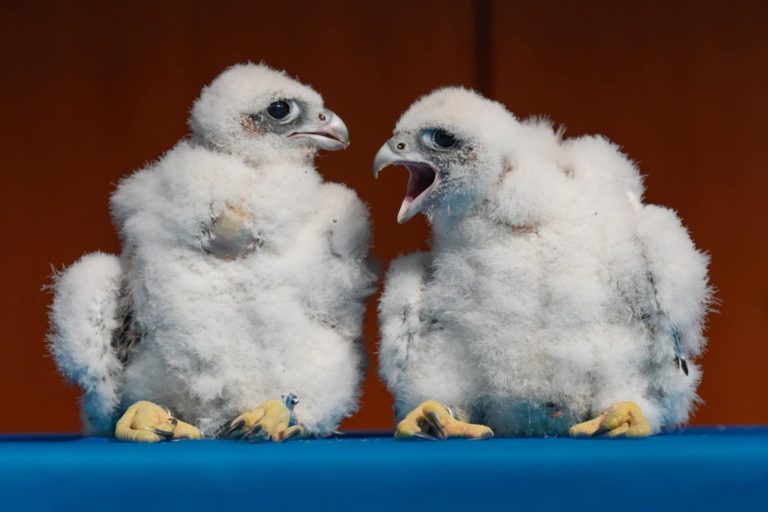
I know many of you have been waiting for this photo, especially if you weren't able to watch the falcon banding earlier today.
Let me announce our two female eyasses Riya and Aria! These names made the final selection out of over 5000 names that were submitted by over 1500 people. "Riya" means beautiful or graceful and was submitted by Carley of La Crosse, WI, and was banded black/blue 35/AB on her left leg. "Aria" means air, noble or lioness, depending on the origin, and was submitted by several different people and was banded black/blue 36/AB. Every year it is a difficult decision to go through all of the names that are submitted, and we had many excellent choices to choose from.
The entire process took less than half an hour, with only two chicks to retrieve, band and return to the nest. The team that does all of this includes many different folks from both Mayo Clinic and the Midwest Peregrine Society. Safety for humans and falcons alike is our top priority, and although I know many of you expressed concern about the delay in the adults returning to the nest box, you have to remember that the adults have been spending very little time in the box this entire week, except for feeding time or during the overnight hours. I can assure you that we closely monitor the adults after all bandings, and both Hattie and Orton were perched within 100 feet of the box once the chicks were returned to the rooftop.
This banding event is quite a milestone in the young falcon's life, but I am happy to report that both chicks were quite healthy, at excellent weights, and very clean of parasites. Great job Hattie and Orton!!
NOTE: All banding, marking, and sampling is being conducted under a federal authorized Bird Banding Permit issued by the U.S. Geological Survey.
May 6, 2025
May 6, 2025
Mystery of the Missing Egg
May 6, 2025
Mystery of the Missing Third Egg
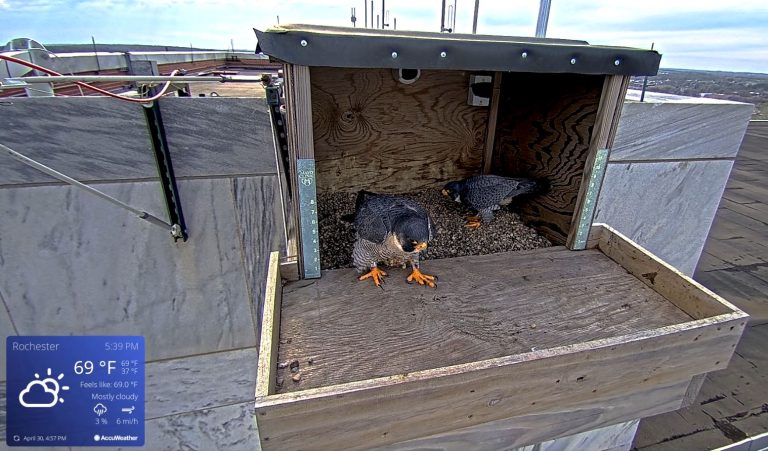
After some AMAZING review time spent by several of the media systems staff, minute by minute, finally revealed that at 5:38 on April 30th, Hattie left the nest box with the broken third egg attached to her abdomen feathering. What caused the egg to crack/break is unknown, and we will never know for certain. The egg could have broken on a sharp gravel piece in the box during incubation, the egg shell could have been thinner than normal and broke under the weight of Hattie, or the egg could have had excessive pressure on it by the adult and broke. What we do know is that at shortly after 2 pm on April 30th, there were three eggs and when she left the box during a normal incubation exchange, there were only two eggs.
What I do know is that this does happen, although rare. There is nothing to indicate a reason for the egg to break under normal incubation behaviors, and there is no way to test the eggshell since it left with Hattie, and it was gone when Hattie returned. Both adults are behaving normally, and there is nothing to indicate a serious problem. Lastly, the egg that was lost most likely did not have an embryo present, based on the fact that it was not observed on Hattie's feathers when she left, and no evidence during the tape review showing evidence of a third chick. Again, this happens and is not something of concern to the team.
I want to give a special shout-out to the media systems engineers who worked for several days on this request for tape review, and noticed the smallest difference in Hattie's feathers, which gave us all an answer to what happened to the third egg. This department is responsible for MANY different aspects of media systems throughout the entire Mayo Clinic health care system, and yet they still dedicated time to help us find an answer. This program is a true testament to the word "TEAM".
May 3, 2025
May 3, 2025
Second chick of 2025
May 3, 2025
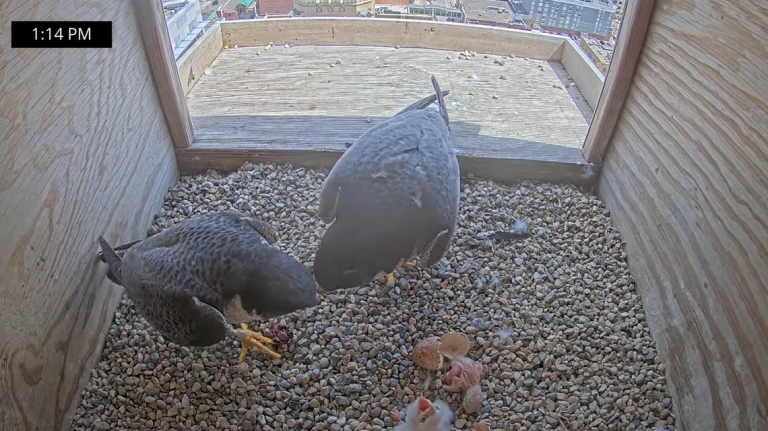
The second chick arrived this afternoon, approximately at 1 pm CST. Both chicks appear to be doing well and are being well cared for by Hattie and Orton.
We're still reviewing the camera footage and will share another update as soon as we have news about the disappearance of the third egg.. Thanks for your patience!
May 2, 2025
May 2, 2025

First chick of 2025
May 2, 2025
Yesterday at 5:23 pm CST in Rochester, Minn., Hattie and Orton welcomed their first chick of the 2025 season.
The chick made it through the night and is being tended to by Hattie. At this stage, the nestling won't eat more than a few bites, but if everything goes well, it will start eating its body weight on a daily basis until it is nearly three weeks old.
We're waiting on the second egg to hatch, but, unfortunately, we don't know yet what happened to the third egg. We're still reviewing the camera footage and will share another update as soon as we have news. Thanks for your patience!
May 1, 2025
May 1, 2025
Anticipating hatch!
May 1, 2025
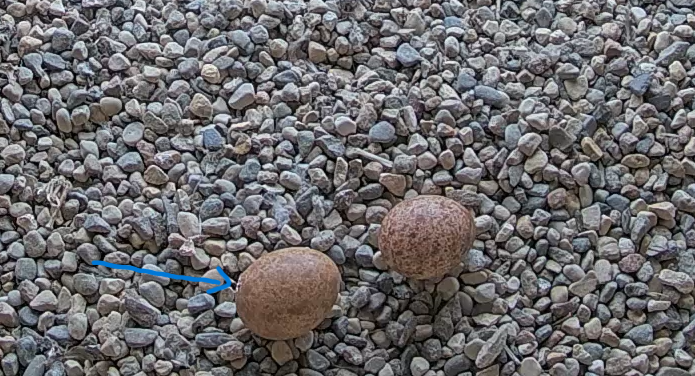
We observed the pip (small hole in the shell) of one egg this morning, so a hatchling is on the way. You may have noticed that there are only two eggs in the nest box this morning. We will review the falcon camera footage to determine what happened to the third egg and will post an update when we have more information. In the meantime, keep an eye out for the first chick.
April 9, 2025
April 9, 2025
Guess Who I Saw this Weekend?
April 9, 2025
Guess Who I Saw This Weekend?
As Minnesota's state coordinator for peregrines, I am responsible for about 55 territories throughout the state. Approximately half of the sites are on natural cliffs, and others are in urban locations from Grand Portage to the La Crosse, WI area, over to St. Cloud and north again to Brainerd. This means I am doing a lot of driving, trying to find the peregrines and reading their bands (if banded).
One of my sites is in Mankato, MN, approximately an hour and a half west of Mayo Clinic. Historically, the peregrines nested underneath a bridge on a pillar over the Blue Earth River. This year, I noticed a new adult female on territory who was interested in a nest box that was installed over 20 years ago but never used. A few weeks later, another team member identified a new female on territory, but she was less than a year old, hatching in 2024. (Remember, Hattie was this same age when she first arrived at Mayo in 2016).
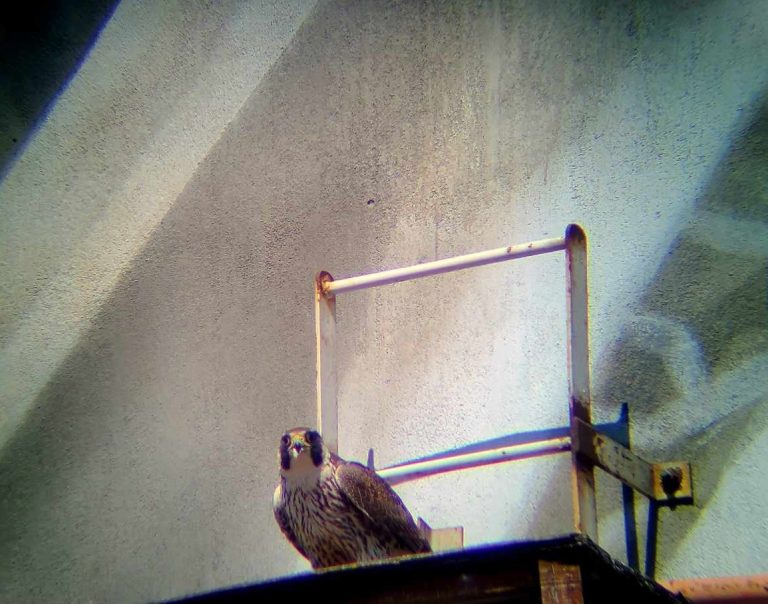
It took us another few weeks to figure out that this new female was banded and to have her sit in just the right place long enough to read the band. Imagine my EXCITEMENT when I discovered that she was black/blue banded V/43. Does this band sound familiar?? It was ONYX!!! One of last year's fledglings, the largest in the brood and the most assertive of the three females. WHOOP WHOOP!!
It is always exciting to discover that one of the birds I've banded has survived to adulthood, but I am even more excited to learn that they are paired up with a mate and occupying a territory. What next? Now we wait and watch. Will she lay eggs or just continue to hang out in town? I have no idea. They are copulating, which is a good sign, and performing aerial displays of courtship. About 25% of the first-year birds in our population reproduce, so it isn't impossible. The very first peregrine to successfully breed in our region was a one-year-old female in Minnesota, MF-1, who produced a single female fledgling named Maud, who went on to nest successfully in Canada.
Stay tuned and I'll share more photos as I can. For now, raise a talon to Onyx and welcome her to the status of territorial falcon. Jackie
March 30, 2025
March 30, 2025
A Total of Three
March 30, 2025
And then there were  !
!
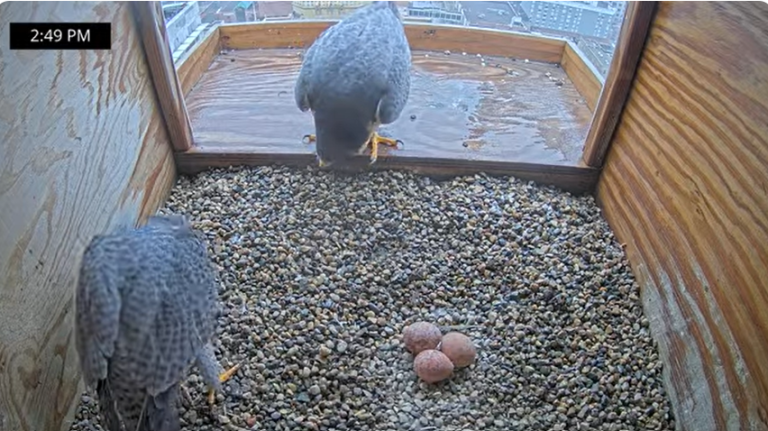
!Egg number 3 arrived sometime between 7:53 am and 11:21 am CST. This definitely hasn't been a "traditional" nesting season for our Rochester Clinic falcon family, but then again, nature isn't an exact science.
Will a 4th egg arrive? Will the clutch stay at 3? I have no idea, but if I had to guess, I would say we are done at 3. Now that I've put myself out there, Hattie and Orton will prove me wrong...and that's OK. That's why I'm still learning after 38 years in this program.
Be aware that Rochester is expected to receive 1-3 inches of snow tonight. Gotta love Minnesota's weather.
March 22, 2025
March 22, 2025
First Egg of 2025!
March 22, 2025
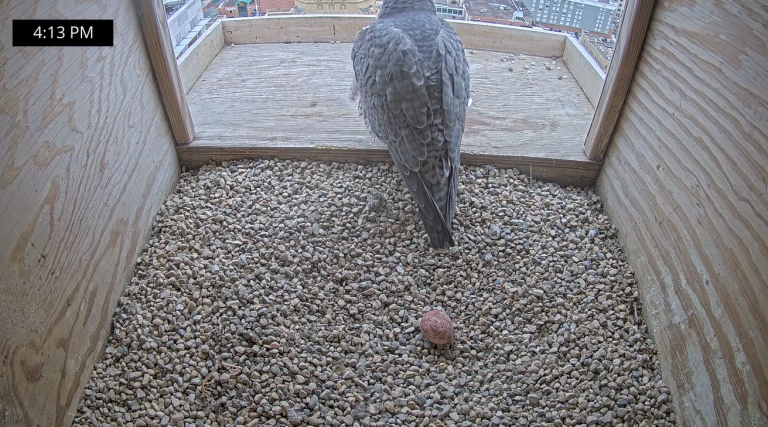
We're happy to report that the first egg of the 2025 season arrived this morning at 7:33 a.m. Hopefully, two to three more eggs will arrive over the next week for a full clutch.
Don't be alarmed if you don't see the adult falcons sitting on the eggs all of the time. True incubation won't begin until the second to last egg is laid.
March 7, 2025
March 7, 2025
Who is Who?
March 7, 2025
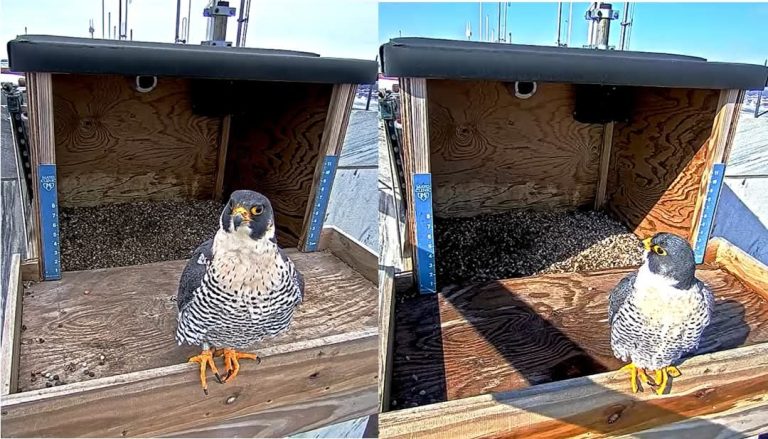
Now that the camera is up and running, I thought it might help remind folks and give some helpful hints to our new fans to identify the peregrines that are currently occupying the Rochester territory: Hattie and Orton. In the photo, Hattie is the falcon on the left and Orton is the falcon on the right.
I use a variety of physical markings to distinguish the birds from one another, in addition to their auxiliary color band on the bird's left leg. Hattie has a black/red band that reads D/35 and Orton has a black/red band that reads N/46. This method of identification is what I use for all of my observations, because of the exact science in the band characters, instead of saying "That falcon looks like Hattie, so it must be Hattie". If I can't get a complete band reading, I continue to try until I'm either successful or I fail. If I fail to get a full band reading, I make a note on the color and the partial identification in my field journal and report the information that way.
In peregrine falcons and most other raptors, the females are considerably larger in size than the males. You may notice when the inside box camera view is showing and a peregrine is in the box, Hattie may fill almost half of the inside dimensions where Orton is considerably smaller in size.
Secondly, you will notice some other subtle cues, especially relating to their head and chest. For example, Hattie is heavily streaked with vertical bars on her "bib" or the area right under her beak, her bib is also slightly "peachy" colored, and she has a dark head but with a small area of white on the side of the head where you might expect to find her ears. Meanwhile, Orton has only a small amount of vertical streaking on his bib, right where it meets his chest feathers, his bib is whiter in color, and his head is solid black.
Lastly, male peregrines have a higher pitch in their vocalizations compared to female peregrines. This difference in pitch is also something I can use when determining the sex of the nestlings at the banding time, in addition to the overall size and weight.
See if you can notice the difference the next time you hear them on the camera. Remember though, that we often have a variety of falcons that are on territory early in the season, so please let us know if you see a bird that doesn't match either photo above. Jackie
February 10, 2025
February 10, 2025
First Signs of Interest
February 10, 2025
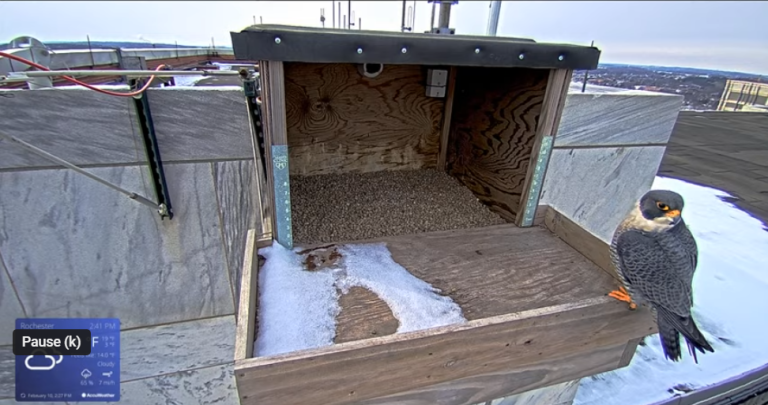
The camera went live on February 3rd, much to the delight of our thousands of fans!
Right now, the box is empty most of the time, but you may see a visitor every once in a while. As the season progresses, the peregrines will start spending more time at and near the box. One of the earliest behaviors you will see them do is make a scrape (depression) in the gravel for the eggs, as well as the male making food deliveries to the female. Orton is the falcon in today's photo, as confirmed by his band number. I hope to get on-site this week to get more observations of the birds and reconfirm "who is who". Jackie
January 12, 2025
January 12, 2025
Welcome to the 2025 Season!
January 12, 2025
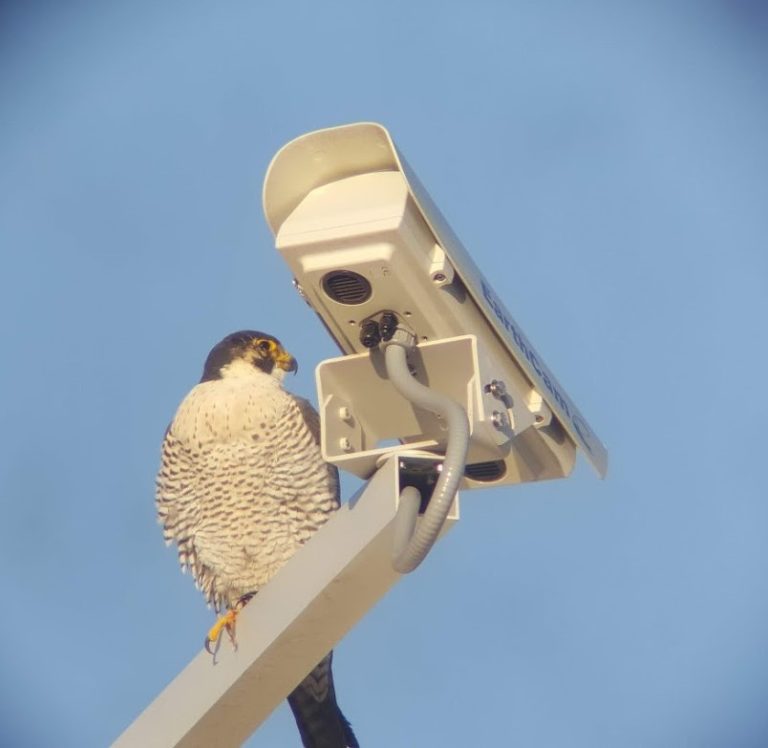
It can only mean one thing when John Olson is on the roof of the Mayo Building in Rochester. Our 2025 Peregrine Falcon season is near!
John is a senior media systems engineer who has been busy adjusting the live camera to provide falcon fans with the best look into our nest box this season. He's also part of the team, along with Jenny, making sure that when any little glitches happen with the streaming, they get us up and running again as soon as possible. They are a valuable part of the peregrine team at Mayo Clinic, and we're so lucky to have them working with us.
Meanwhile, I've been observing the area to see what falcons are in the area, and whether Hattie and Orton will once more set up residence on campus. So far, I've only observed Hattie and Orton, but it is still early in the season. Time will tell and I'm so excited to have you join us in this journey!