
President Franklin D. Roosevelt Visits Rochester
On a sweltering day in August 1934, thousands of Rochester residents and visitors watched as President Franklin D. Roosevelt honored Doctors William J. and Charles H. Mayo “as teachers of America” and presented them with a bronze plaque at Soldiers Memorial Field in Rochester.
An even larger audience followed the ceremony via radio broadcast.
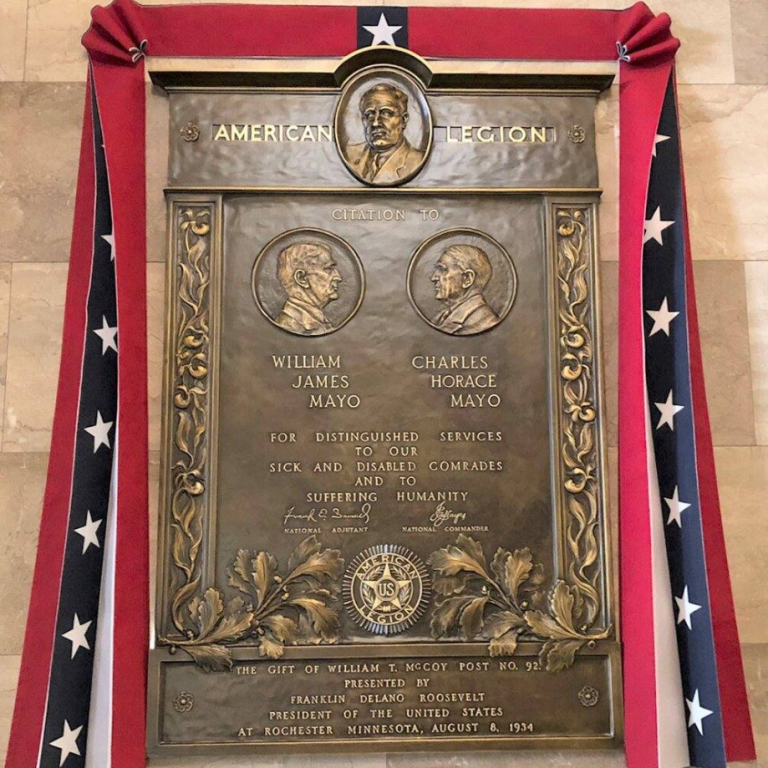
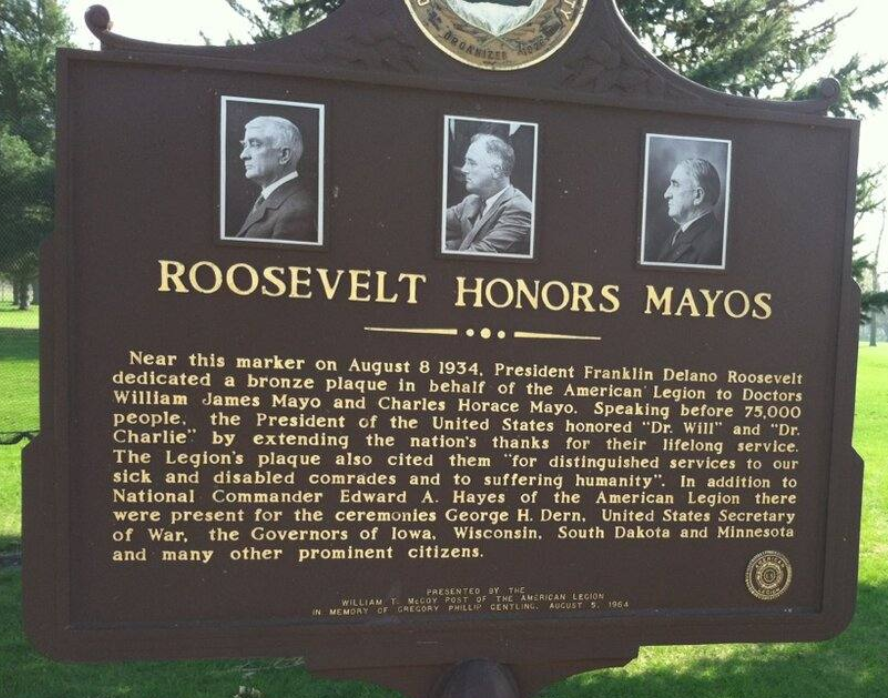
Two plaques in Rochester memorialize President Roosevelt’s visit in 1934:
- Plummer Building lobby (above) — This bronze tablet was unveiled at the ceremony. Presented by the American Legion, it featured medallions of both Mayo brothers in profile. They were created by Louise Mayo, daughter of Dr. Charles H. and Edith G. Mayo.
- Soldiers Memorial Field (at left) — A plaque commemorates the site of the ceremony.
Mayo Clinic has a unique and long-standing history with the White House. Spanning more than 150 years, this relationship is bipartisan and nonpolitical, grounded in Mayo’s primary value, “the needs of the patient come first.”
Presidential family members from both parties have been loyal patients, trusted advisers and generous supporters of Mayo Clinic.
The Other White House
It’s also interesting to note that President Roosevelt returned to Rochester a second time. During the fall of 1938, he and First Lady Eleanor Roosevelt accompanied their son, James, who had surgery at Saint Marys Hospital.
Rochester became the “Western White House” as FDR monitored crisis conditions in Europe, which was moving toward the start of World War II.
Eleanor Roosevelt socialized with the Mayo Clinic staff. She invited the families of James Roosevelt’s physicians, George Eusterman, M.D., and Howard Gray, M.D., to visit the White House during the Christmas and New Year’s holidays.
You can learn more about Mayo Clinic and the presidency in the Heritage Film “Mayo Clinic and the White House: Caring for America’s First Families.” Narrated by award-winning broadcast journalist Tom Brokaw, emeritus member of the Mayo Clinic Board of Trustees, it covers more than a century of wide-ranging presidential connections to Mayo.