Origins of the Mayo Clinic Name
The Mayo brothers referred to their practice as “the group.” When formality was required, the names of partners were highlighted, consistent with other medical practices. By 1912, the partnership name had become unwieldly: The Doctors Mayo, Stinchfield, Graham, Plummer, Judd and Balfour.
Fortunately, by that time, an alternative name emerged. As recognition of the Mayos’ practice spread among the medical profession, increasing numbers of doctors, nurses and other health care professionals made their way to Rochester, Minnesota, to learn from the Mayos. With their open-door philosophy of sharing information, the Mayos obligingly set up observation galleries — similar to bleachers — in the hospital rooms where they operated. Visitors crowded the galleries and referred to these informal educational sessions as “the Mayos’ clinic.”
The name “Mayo Clinic” was picked up by railroads as a shorthand reference when directing patients and visitors to Rochester, and it became widespread among the public by glowing reports in the newspapers and magazines of the era.
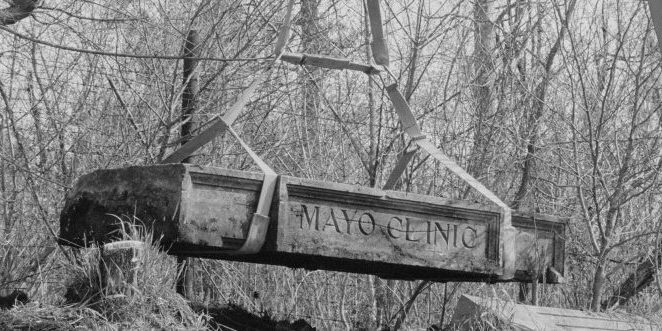
In 1914, when the Mayos opened the first building that was custom designed for their practice, the name “Mayo Clinic” became official and was carved into the lintel over the main entrance. When this structure was replaced by the Harold W. Siebens Medical Education Building, which opened in 1989, architectural fragments were salvaged. The lintel was buried in a landfill, from which it was later excavated and installed over the door of the Heritage Hall museum on the Rochester campus.
The name “Mayo Clinic” has continued for more than a century, and today it is recognized among the premier brand names in the world.